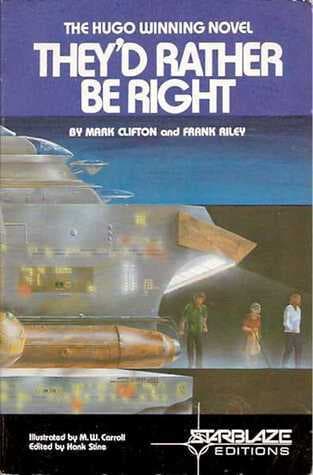
They'd Rather Be Right
About this book
Bossy was right. Always. Invariably. She was limited only in that she had to have facts -- not assumptions -- with which to work. Given those facts, her conclusions and predictions were inevitably correct. And that made Bossy a 'ticking bomb.'Bossy had been designed as a servomechanism for guiding airplanes. But she became something much greater: a hypercomputer. Soon the men who worked with Bossy found themselves able to solve their problems, to erase their prejudices - in short, to think.Did the world welcome Bossy with open arms and glad cries? No, because for four decades the world had been in the grip of opinion control, and Bossy represented a serious threat to that dominance. So Bossy had to go underground, and work in hiding. Which was why Joe Carter, the worlds only true telepath, and two brilliant Professors had to assume the role of Skid Row bums. All this is only the beginning of one of the most thoughtfully written, and thought provoking, science fiction novels ever written. It shows convincingly and compellingly, what would happen if everyone in the world were given a single blunt command: Think or die.Only a small handful of people are mature enough to realize that they don’t know all the answers. And it was only to this handful that Bossy offered the greatest gift of all: immortality. But all people wanted immortality, wanted it with a fixed and burning desire. And gradually the tension increased, the mobs grew restless, the military became more demanding—and the 'bomb' ticked swiftly on. And it was up to Joe Carter to stave off catastrophe. THE FOREVER MACHINE is full of excitement, both physical and mental. It is full, too, of rich rewards for the reader who appreciates genuinely mature philosophy tinged with gentle irony. And among other things, it is that rare event: a science fiction novel based on a brand-new idea.Cover art by Wallace Wood.
Where to buy
No purchase options available at this time.
More by Mark Clifton
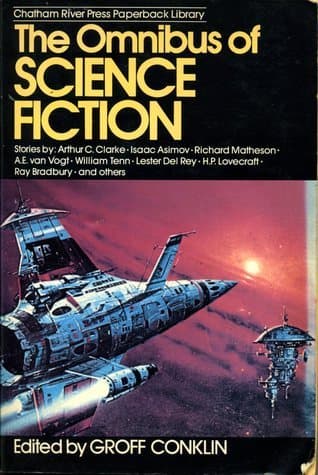
Omnibus of Science Fiction
Jack Vance, André Maurois, Ray Bradbury, Arthur C. Clarke, Jack London, H.P. Lovecraft, Theodore Sturgeon, L. Sprague de Camp, John D. MacDonald, Isaac Asimov, William Tenn, Anthony Boucher, Fredric Brown, Richard Matheson, Donald A. Wollheim, Fletcher Pratt, Damon Knight, Lester del Rey, A.E. van Vogt, Eric Frank Russell, Robert Abernathy, James Blish, H.B. Fyfe, Alan E. Nourse, Murray Leinster, Katherine MacLean, David H. Keller, Lewis Padgett, Groff Conklin, Ralph Williams, A.J. Deutsch, Mark Clifton, Paul Ernst, Wyman Guin, Ross Rocklynne, Chester S. Geier, Ann Griffith, Raymond F. Jones, Russ Winterbotham, W. Hilton-Young, John Leimert, Ralph Robin, B.F. Ruby, Will H. Gray
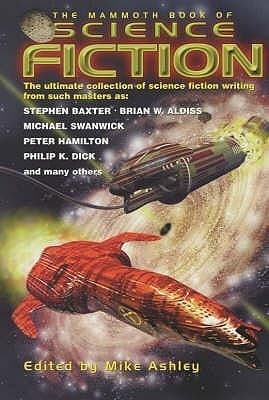
The Mammoth Book of Science Fiction
Robert Reed, Stephen Baxter, Michael Swanwick, Brian W. Aldiss, Greg Egan, Kim Stanley Robinson, Geoffrey A. Landis, Philip K. Dick, Connie Willis, John Morressy, Robert Sheckley, Damon Knight, Eric Frank Russell, Clifford D. Simak, Eric Brown, Mark Clifton, Peter F. Hamilton, Colin Kapp, H. Chandler Elliott, George C. Wallis, Francis Lillie Pollock
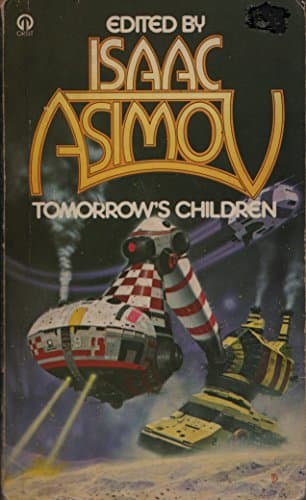
Tomorrow's Children: 18 Tales of Fantasy and Science Fiction
Margaret St. Clair, Zenna Henderson, Fritz Leiber, Ray Bradbury, Philip K. Dick, Robert A. Heinlein, Robert Sheckley, James H. Schmitz, Isaac Asimov, Stephen Vincent Benét, Damon Knight, Jerome Bixby, Clifford D. Simak, Lewis Padgett, Mark Clifton, Will F. Jenkins, Gertrude Friedberg, William Lee