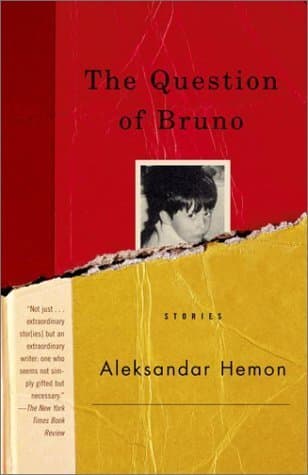
The Question of Bruno
About this book
Aleksandar Hemon moved to the U.S. from Bosnia in the early 1990s, prior to the siege of Sarajevo. He swiftly learned English and began writing, in his adopted language, stories about the traumas of immigrant experience and the pain of witnessing the war from his American exile. His impressive debut, The Question of Bruno, may lack the fluency and imaginative élan of Kundera and the linguistic density and sophistication of Conrad (both of whom Hemon specifically invokes), yet these stories have a haunting power that lingers long after a first reading. By turns tragic and darkly comic, the stories are a mixed bag in terms of style. They are unified, however, by theme. In "Islands," for example, a boy and his family visit their Uncle Julius on the island of Mljet, which is infested by the very mongooses that were imported to deal with the snake problem. Julius, veteran of a Stalinist prison camp, takes a stoical "So that's how it is, he said, it's all one pest after another, like revolutions." And when the family returns to Sarajevo, they are greeted by their neglected, starved cat, shaking "with irreversible hatred." The hungry feline returns in another story, when we learn that Sarajevo under siege was filled with starving cats, which were eaten by starving dogs. If it's symbolism you're after, look no further.One of the best stories, "The Sorge Spy Ring," wonderfully evokes a sad childhood spent in the shadow of Tito's cold war repressions. A man buys his son a portable telegraph set, and the two communicate in Morse code in the privacy of their own home--but later the father is arrested for espionage, and as Tito finally dies, he too languishes on his deathbed, weakly sucking a banana. The image is both poignant and pathetic. It's also the sort of tight close-up that Hemon loves (the camera and the television are dominant images, as one might expect from a writer who resorts to CNN to find out what's happening at home). There are moments when his language is slightly unidiomatic and offkey, as if he's leaned too heavily on a well-thumbed thesaurus. On the whole, though, this is an honest, vivid, and sometimes brilliant collection. --Jonathan Allison
Where to buy
No purchase options available at this time.
More by Aleksandar Hemon
Best European Fiction 2010
Aleksandar Hemon
Best European Fiction 2011
Aleksandar Hemon, Colum McCann
Best European Fiction 2012
Aleksandar Hemon, Nicole Krauss
Best European Fiction 2013
John Banville, A.S. Byatt, Aleksandar Hemon, Dulce Maria Cardoso, Sylwia Chutnik, Bernardo Atxaga, Gyrðir Elíasson, Semezdin Mehmedinović, Tiina Raevaara, Mike McCormack, Eloy Tizón, Bernard Comment, Marie Redonnet, Miklós Vajda, Paul Emond, Christina Hesselholdt, Ari Behn, Lydia Mischkulnig, Dan Lungu, Kirill Kobrin, Kristiina Ehin, Dragan Radulović, Krikor Beledian, Lasha Bugadze, Gundega Repše, Mirana Likar Bajželj, Tomas Mac Siomoin, Vitalie Ciobanu, Balla, Borivoje Adašević, Ieva Toleikytė, Ray French, Žarko Kujundžiski, Zehra Çırak, Tania Malyarchuk, Rumen Balabanov, Daniel Batliner