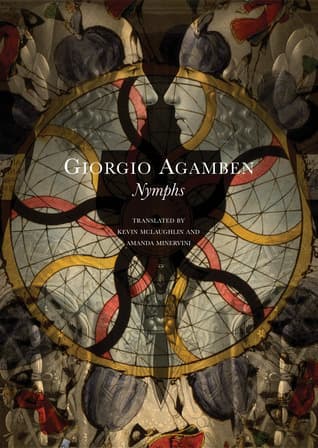
Nymphs
About this book
In 1900, Dutch art historians André Jolles and Aby Warburg constructed an experimental dialogue in which Jolles supposed he had fallen in love with the figure of a young woman in a painting: “A fantastic figure—shall I call her a servant girl, or rather a classical nymph?…what is the meaning of it all?…Who is the nymph? Where does she come from?” Warburg’s response: “in essence she is an elemental spirit, a pagan goddess in exile,” serves as the touchstone for this wide-ranging and theoretical exploration of female representation in iconography.In Nymphs, the newest translation of Italian philosopher Giorgio Agamben’s work, the author notes that academic research has lingered on the “pagan goddess,” while the concept of “elemental spirit,” ignored by scholars, is vital to the history of iconography. Tracing the genealogy of this idea, Agamben goes on to examine subjects as diverse as the aesthetic theories of choreographer Domineco da Piacenza, Friedrich Theodor Vischer’s essay on the “symbol,” Walter Benjamin’s concept of the dialectic image, and the bizarre discoveries of photographer Nathan Lerner in 1972. From these investigations, there emerges a startlingly original exploration of the ideas of time and the image.Agamben is the rare writer whose ideas and works have a broad appeal across many fields, and Nymphs will engage not only the author’s devoted fans in philosophy, legal theory, sociology, and literary criticism, but his growing audience among art theorists and historians as well.
Where to buy
No purchase options available at this time.
More by Giorgio Agamben
Che cos'è il contemporaneo?
Giorgio Agamben

Creation and Anarchy: The Work of Art and the Religion of Capitalism
Giorgio Agamben

Democracy in What State?
Slavoj Žižek, Giorgio Agamben, Alain Badiou, Jacques Rancière, Wendy Brown, Kristin Ross, Jean-Luc Nancy, Daniel Bensaïd

Homo Sacer: Sovereign Power and Bare Life
Giorgio Agamben