
Means Without End: Notes on Politics
About this book
An essential reevaluation of the proper role of politics in contemporary life. A critical rethinking of the categories of politics within a new sociopolitical and historical context, this book builds on the previous work of the distinguished political philosopher Giorgio Agamben to address the status and nature of politics itself. Bringing politics face-to-face with its own failures of consciousness and consequence, Agamben frames his analysis in terms of clear contemporary relevance. He proposes, in his characteristically allusive and intriguing way, a politics of gesture-a politics of means without end. Among the topics Agamben takes up are the "properly" political paradigms of experience, as well as those generally not viewed as political. He begins by elaborating work on biopower begun by Foucault, returning the natural life of humans to the center of the polis and considering it as the very basis for politics. He then considers subjects such as the state of exception (the temporary suspension of the juridical order); the concentration camp (a zone of indifference between public and private and, at the same time, the secret matrix of the political space in which we live); the refugee, who, breaking the bond between the human and the citizen, moves from marginal status to the center of the crisis of the modern nation-state; and the sphere of pure means or gestures (those gestures that, remaining nothing more than means, liberate themselves from any relation to ends) as the proper sphere of politics. Attentive to the urgent demands of the political moment, as well as to the bankruptcy of political discourse, Agamben's work brings politics back to life, and life back topolitics.Giorgio Agamben teaches philosophy at the College International de Philosophie in Paris and at the University of Macerata in Italy. He is the author of Language and Death (1991), Stanzas (1992), and The Coming Community (1993), all published by the University of Minnesota Press.Vincenzo Binetti is assistant professor of Romance languages and literature at the University of Michigan. Cesare Casarino teaches in the Department of Cultural Studies and Comparative Literature at the University of Minnesota.
Where to buy
No purchase options available at this time.
More by Giorgio Agamben
Che cos'è il contemporaneo?
Giorgio Agamben

Creation and Anarchy: The Work of Art and the Religion of Capitalism
Giorgio Agamben
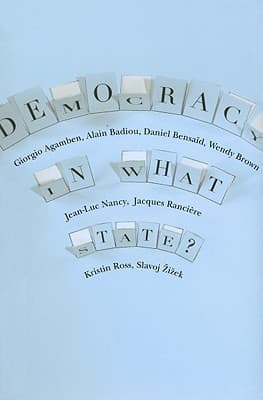
Democracy in What State?
Slavoj Žižek, Giorgio Agamben, Alain Badiou, Jacques Rancière, Wendy Brown, Kristin Ross, Jean-Luc Nancy, Daniel Bensaïd

Homo Sacer: Sovereign Power and Bare Life
Giorgio Agamben