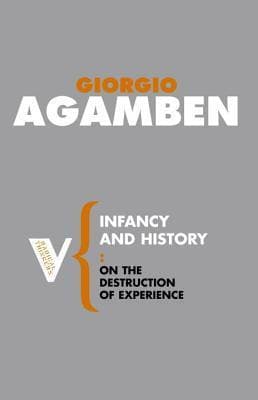
Infancy and History: On the Destruction of Experience
About this book
How and why did experience and knowledge become separated? Is it possible to talk of an infancy of experience, a “dumb” experience? For Walter Benjamin, the “poverty of experience” was a characteristic of modernity, originating in the catastrophe of the First World War. For Giorgio Agamben, the Italian editor of Benjamin’s complete works, the destruction of experience no longer needs daily life in any modern city will suffice.Agamben’s profound and radical exploration of language, infancy, and everyday life traces concepts of experience through Kant, Hegel, Husserl and Benveniste. In doing so he elaborates a theory of infancy that throws new light on a number of major themes in contemporary the anthropological opposition between nature and culture; the linguistic opposition between speech and language; the birth of the subject and the appearance of the unconscious. Agamben goes on to consider time and history; the Marxist notion of base and superstructure (via a careful reading of the famous Adorno–Benjamin correspondence on Baudelaire’s Paris); and the difference between rituals and games.Beautifully written, erudite and provocative, these essays will be of great interest to students of philosophy, linguistics, anthropology and politics.
Where to buy
No purchase options available at this time.
More by Giorgio Agamben
Che cos'è il contemporaneo?
Giorgio Agamben

Creation and Anarchy: The Work of Art and the Religion of Capitalism
Giorgio Agamben
Democracy in What State?
Slavoj Žižek, Giorgio Agamben, Alain Badiou, Jacques Rancière, Wendy Brown, Kristin Ross, Jean-Luc Nancy, Daniel Bensaïd

Homo Sacer: Sovereign Power and Bare Life
Giorgio Agamben