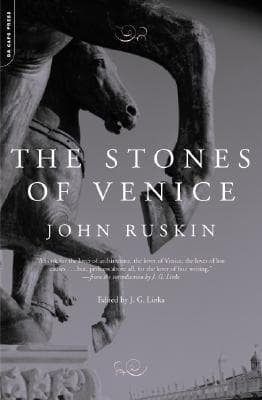
The Stones of Venice
by John Ruskin
About this book
"It is in Venice, and in Venice only, that effectual blows can be struck at this pestilent art of the Renaissance. Destroy its claims to admiration there, and it can assert them nowhere else." This was Ruskin's war cry as he entered the now almost forgotten Battle of the Styles on the side against "the school which has conducted men's inventive and constructional faculties from the Grand Canal to Gower Street."But first the reader must know the difference between right and wrong; he must find out for himself the best way of doing everything. "I shall give him stones, and bricks and straw, chisels and trowels and the ground, and then ask him to build, only helping him if I find him puzzled."Unhappily, both these exciting objectives were attained only after the expenditure of nearly half-a-million words; glorious words, but too many. For fifty years, The Stones of Venice was read by all who went there and thousands who could not; the sightseers whom the city captivates today seldom have its greatest guidebook with them.It is the aim of this new edition to put a fascinating book within reach of travelers--active or armchair--with limited resources of time. Much that was superfluous has been omitted; what remains is the essence of a now very readable and portable book. It is a book for the lover of architecture, the lover of Venice, the lover of lost causes, and, perhaps above all, for the lover of fine writing.
Where to buy
No purchase options available at this time.
More by John Ruskin
On Art and Life
John Ruskin
Praeterita: The Autobiography Of John Ruskin
John Ruskin
Sesame and Lilies
John Ruskin, Jane Epstein Hunter
The Complete Harvard Classics - ALL 71 Volumes: The Five Foot Shelf & The Shelf of Fiction: The Famous Anthology of the Greatest Works of World Literature
William Shakespeare, Jonathan Swift, George Eliot, Mark Twain, Walter Scott, William Makepeace Thackeray, Jane Austen, Virgil, Homer, Henry James, Euripides, Aeschylus, Sophocles, Daniel Defoe, Plato, Herodotus, Aristophanes, George Sand, John Ruskin, John Fletcher