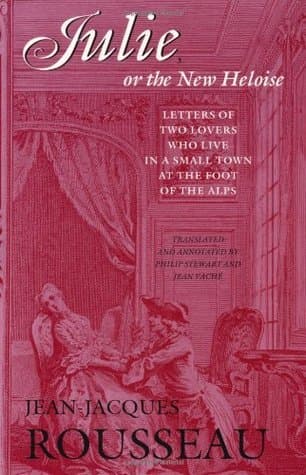
Julie, or the New Heloise
About this book
An elegant translation of one of the most popular novels of its time. Rousseau's great epistolary novel, Julie, or the New Heloise, has been virtually unavailable in English since 1810. In it, Rousseau reconceptualized the relationship of the individual to the collective and articulated a new moral paradigm. The story follows the fates and smoldering passions of Julie d'Etange and St. Preux, a one-time lover who re-enters Julie's life at the invitation of her unsuspecting husband, M. de Wolmar. The complex tones of this work made it a commercial success and a continental sensation when it first appeared in 1761, and its embodiment of Rousseau's system of thought, in which feelings and intellect are intertwined, redefined the function and form of fiction for decades. As the characters negotiate a complex maze of passion and virtue, their purity of soul and honest morality reveal, as Rousseau writes in his preface, "the subtleties of heart of which this work is full." A comprehensive introduction and careful annotations make this novel accessible to contemporary readers, both as an embodiment of Rousseau's philosophy and as a portrayal of the tension and power inherent in domestic life.
Where to buy
No purchase options available at this time.
More by Jean-Jacques Rousseau
A Discourse on Political Economy
Jean-Jacques Rousseau
Chloe Plus Olivia: An Anthology of Lesbian Literature from the Seventeenth Century to the Present
Emily Dickinson, Mary Eleanor Wilkins Freeman, Willa Cather, Christina Rossetti, Virginia Woolf, Rita Mae Brown, Anaïs Nin, Sigmund Freud, Katherine Mansfield, Carson McCullers, Sarah Orne Jewett, Jewelle Gomez, Charles Baudelaire, J. Sheridan Le Fanu, Djuna Barnes, William Cullen Bryant, Vita Sackville-West, Audre Lorde, Gertrude Stein, Radclyffe Hall, Henry Handel Richardson, Helen R. Hull, Amy Lowell, Katherine Bradley, Maria Edgeworth, Juana Inés de la Cruz, Jean-Jacques Rousseau, Henry Fielding, Michel de Montaigne, Charlotte Mew, H.D., Angelina Weld Grimké, Constance Fenimore Woolson, Colette, Katharine Lee Bates, Aphra Behn, Lillian Faderman, Charlotte Charke, Clemence Dane, Renée Vivien, Anne Lister, William Rounseville Alger, Rose O'Neill, Anna Seward, Katherine Philips, Edith Cooper, Richard von Krafft-Ebing, Marie Madeleine, Eleanor Butler, Sarah Ponsonby
Discourse on the Origin of Inequality
Jean-Jacques Rousseau

Discourse on the Sciences and Arts and Polemics
Jean-Jacques Rousseau