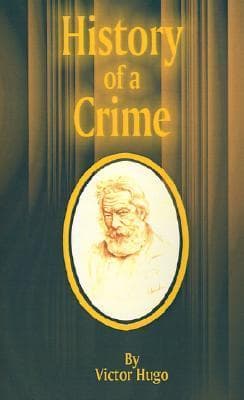
History of a Crime: Deposition of a Witness
by Victor Hugo
About this book
By the age of twenty-nine Victor Hugo was the established master of French poetry, drama and the novel; by virtue of Les Orientales, Hernani and Notre Dame de Paris respectively. He would write for nearly fifty-four more years with no significant depreciation in his work. Hugo wrote, in Dieu (God), that Satan had sent three evils into this world; war, capitol punishment and imprisonment. On April 13, 1845 Hugo was made a Peer de France and on June 4th he was elected to the National Assembly. The revolution of 1848 marked a watershed in the social and political opinions and ultimately in the course of the great writer's literary career. However, for Victor Hugo the course that would lead him from the right to the left in the Chamber of Deputies, unfolded gradually over the first two years of the upheaval. Hugo's reputation as a critic already insured that his preventative arrest along with other dissenting parliamentarians. Hugo also futilely attempted to form a resistance committee and tried to rally popular support in Paris for a new round of barricades. These moments are the subject of his novel History of a Crime. By the time the great romantic had begun his exile he had turned one hundred and eighty degrees, from an adherent of the restored monarchy to a champion of a democratic and social republic. When his political activities forced him to flee Paris, he started writing less than 24 hours after he arrived in Brussels. In less than five months, he completed History of a Crime, which contains vicious attacks on Napoleon III. Belgium asked Hugo to leave because they were forced to maintain friendly relations with France. Hugo then went to the small island of Jersey not far from the French coast, but he would never make a real home for himself there. There he published Les Châtements a book of poems further defaming Napoleon III. When England allied itself with Napoleon III (1855) Hugo attacked the Queen as well, with this he overstepped his welcome in Jersey and was told to leave the island (Jersey was a British holding).
Where to buy
No purchase options available at this time.
More by Victor Hugo
#1 البؤساء
Victor Hugo, فيكتور هوجو
100 Eternal Masterpieces of Literature #1
Fyodor Dostoevsky, Aldous Huxley, Charles Dickens, Lewis Carroll, George Eliot, Gustave Flaubert, Edgar Rice Burroughs, Louisa May Alcott, Anne Brontë, Arthur Conan Doyle, Jane Austen, Johann Wolfgang von Goethe, Joseph Conrad, Victor Hugo, Emily Brontë, Homer, Alexandre Dumas, E.M. Forster, Honoré de Balzac, Charlotte Brontë, Miguel de Cervantes Saavedra, Theodore Dreiser, Henri Barbusse, Big Cheese Books

50 Masterpieces you have to read before you die vol: 1
Leo Tolstoy, Charles Dickens, Lewis Carroll, George Eliot, Gustave Flaubert, James Joyce, Edgar Rice Burroughs, Oscar Wilde, Louisa May Alcott, Willa Cather, Fyodor Dostoyevsky, Anne Brontë, Arthur Conan Doyle, Jane Austen, Joseph Conrad, Victor Hugo, D.H. Lawrence, Emily Brontë, Henry James, Alexandre Dumas, Bram Stoker, E.E. Cummings, Daniel Defoe, Honoré de Balzac, Charlotte Brontë, Miguel de Cervantes Saavedra
A Very French Christmas: The Greatest French Holiday Stories of All Time
Guy de Maupassant, Victor Hugo, Anatole France, Irène Némirovsky, Alphonse Daudet, Paul Arène, Dominique Fabre, Jean-Philippe Blondel, Gustave Droz, François Coppée