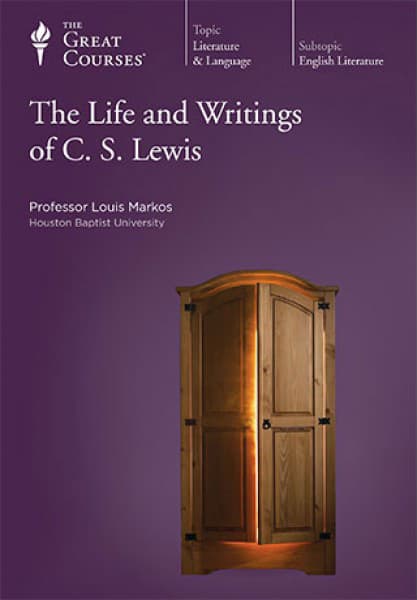
The Life and Writings of C. S. Lewis
About this book
In these lectures you will cover Lewis's spiritual autobiography and other creative works, as well as his scholarly writings that reflect on pain and grief, love and friendship, prophecy and miracles, and education and mythology.Lewis's works have continued to gain in power and popularity over the last half-century. Much has been written to assess his lasting legacy and why he has had such a profound impact on 20th-century readers.As well as delving into the plots of Lewis's enduring works, you will consider questions such as:From the magisterial "Oxford History of English Literature" to children's fantasy books, how did Lewis write with such brilliance and coherence across so many distinct and demanding fields?What were the people, events, and influences that shaped his thought, his character, and the spiritual drama at his life's core?What do Lewis's fictional and factual autobiographies reveal about his conversion and his efforts to "explain and defend the belief that has been common to nearly all Christians at all times"?How did he argue for his ethical notion of "the Tao"—a non-relative set of standards, held widely across all cultures, which modern ideologies often distort?How did he use his apologetical writings to come to grips with perennial spiritual questions involving miracles; the meaning of suffering; the reality of heaven and hell; and the nature of choice, sin, and salvation?How do his scholarly works analyze modern prejudices about the past and offer a vivid, accessible defense of medieval and Renaissance thought?In Lectures 7 through 11, we turn to Lewis the fictional novelist:The unfallen world of Perelandra in the Space Trilogy (1938–45)The beloved Chronicles of Narnia (1950–1956) children's series for which he is perhaps best knownTill We Have Faces (1961), a mature and beautiful reworking of the Cupid and Psyche myth whose heroine is patterned after Lewis's wife, Joy.Professor Louis Markos is a member of Phi Beta Kappa and has won teaching awards at both the University of Michigan and Houston Baptist University. He presents this course as a sympathetic, deeply felt exposition of Lewis's multifaceted thought and works, making no secret of the fact that he is a longtime and enthusiastic fan of Lewis's writings.
Where to buy
No purchase options available at this time.
More by Louis A. Markos
From A to Z to Narnia with C.S. Lewis
Louis A. Markos
From Achilles to Christ: Why Christians Should Read the Pagan Classics
Louis A. Markos
From Plato to Christ: How Platonic Thought Shaped the Christian Faith
Louis A. Markos
From Plato to Post-modernism: Understanding the Essence of Literature and the Role of the Author
Louis A. Markos