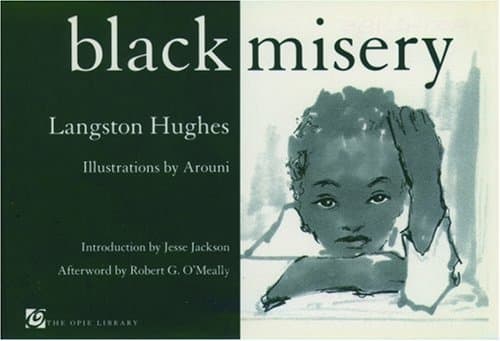
Black Misery
About this book
Black Misery was first published in 1969, but the gentle, funny, and sometimes melancholy words of Langston Hughes still cause a blink of recognition. After 25 years, it remains relevant in our own time. As you turn the pages you may say, "I remember feeling like that!" You may say, "I feellike that now."As you look at Arouni's black and white illustrations and read the short but powerful one sentence captions, you feel the predicament of a black child adjusting to the new world of integration of the 1960s. You feel the mix of hope and dismay that characterized the decade.Langston Hughes was a writer who often made his readers ask hard questions about life. In Black Misery he wrote about prejudice and indifference, but he wrote with humor and compassion. Today--just as we did 25 years ago-we smile and even laugh, and we also understand that some things are more thanhard, are more than sad. They are pure misery.Black Misery was the last book that Langston Hughes wrote. He died in May 1967, while working on the manuscript.
Where to buy
No purchase options available at this time.
More by Langston Hughes

African-American Poetry: An Anthology, 1773-1927
Langston Hughes, George Moses Horton, Frances Ellen Watkins Harper, James Monroe Whitfield, Joan R. Sherman, Charlotte Forten Grimké, James Madison Bell, Phillis Wheatley Peters, Joshua McCarter Simpson, Alfred Islay Walden
Amazing Faces
Jane Yolen, Pat Mora, Langston Hughes, Nikki Grimes, Joseph Bruchac, Lee Bennett Hopkins, Chris K. Soentpiet, Rebecca Kai Dotlich, J. Patrick Lewis, Jude Mandell, Janet S. Wong, Carole Boston Weatherford, Kam Mak, Jane Medina, Mary E. Cronin, Tom Robert Shields, Prince Redcloud

America Street: A Multicultural Anthology of Stories
Grace Paley, Nicholasa Mohr, Naomi Shihab Nye, Langston Hughes, Gary Soto, Lensey Namioka, Gish Jen, Toni Cade Bambara, Francisco Jiménez, Toshio Mori, Robert Cormier, Anne Mazer, Michele Wallace, Duane Big Eagle, Mary K. Mazotti
Blood Wedding and Yerma
Langston Hughes, Federico García Lorca