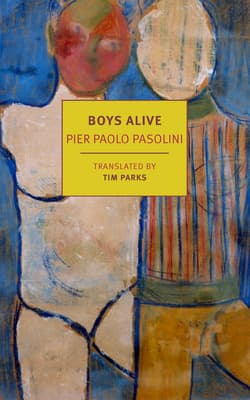
Boys Alive
About this book
A daring novel, once widely censored, about the scrappy, harrowing, and inventive lives of Rome's unhoused youth by one of Italy's greatest film directors.Boys Alive, published in 1955, was Pier Paolo Pasolini's first novel and remains his best-known work of fiction. He'd moved to Rome a few years before, after finding himself embroiled in a provincial sex scandal, and the impact of the city on Pasolini—its lively, aggressive dialect, its postwar squalor and violence—was accompanied by a new awareness that for him respectability was no longer an “Like it or not, I was tarred with the brush of Rimbaud . . . or even Oscar Wilde.” Urgently looking for teaching work, walk-on parts in films, literary journalism, anything to achieve independence and security, he was drawn to other outcasts who cared nothing for bourgeois values, who lived intensely, carelessly, refusing to be hampered by scruple and convention.This was the context in which he began to work on a novel, and though socialism was the intellectual and artistic fashion of the day and Pasolini was a socialist, his book was completely free of any sentimental or patronizing concern for the plight of the underprivileged. Pasolini revels in the vitality of the squalor he so lavishly and energetically evokes. In Boys Alive, he devotes his native lyricism and vast literary resources to conjuring up an urban inferno as vast and hideous as it is colorful and dynamic.There is no grand plot, but Pasolini’s narrative voice moves like a heat-seeking missile, infallibly locking onto situations of great intensity, conflict and comedy. Possessing nothing, his young characters fight to survive and to live. At all costs they must have fun; boredom is death. And if food and fun must be paid for, then money will be looting, hustling, scavenging, stealing. Once found it is immediately squandered on sharp clothes and shoes, drunk away, gambled away, or simply lost. Boasting and exhibitionism are the norm, and every boy aspires to be the toughest, the shrewdest, the most unscrupulous punk on the block. As each new episode begins—a warehouse heist, an evening’s gambling, a search for sex—the reader can only tremble, waiting for disaster to strike. Everything is up in the air. Nothing is predictable.Tim Parks' new translation of Pasolini's early masterpiece brings out the salt and intelligence of this vital and never less than scandalous work of art.
Where to buy
No purchase options available at this time.
More by Pier Paolo Pasolini
A Nebulosa
Pier Paolo Pasolini
City Lights Pocket Poets Anthology
Allen Ginsberg, Gregory Corso, Lawrence Ferlinghetti, Kenneth Rexroth, Antler, Harold Norse, Diane di Prima, Denise Levertov, Jacques Prévert, Anne Waldman, Pier Paolo Pasolini, Andrei Voznesensky, Jack Kerouac, Frank O'Hara, Bob Kaufman, Robert Bly, Jack Hirschman, Peter Orlovsky, Anselm Hollo, Robert Duncan, Ernesto Cardenal, Pablo Picasso, Jerome Rothenberg, Marie Ponsot, Kenneth Patchen, Philip Lamantia, Vladimir Mayakovsky, Daisy Zamora, Malcolm Lowry, Nicanor Parra, Robert Nichols, Janine Pommy-Vega, La Loca, Charles Upton, Antonio Porta, Alberto Blanco, Adam Cornford, Rosario Murillo, Pete Winslow, Stefan Brect
Heretical Empiricism
Pier Paolo Pasolini
Il caos
Pier Paolo Pasolini