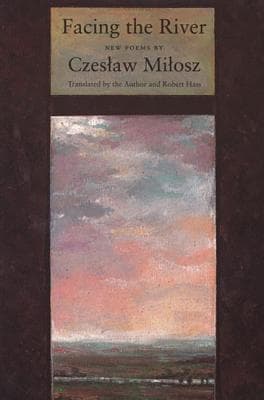
Facing The River: A Nobel Laureate's Later Poems on Time, Imagination, and Human Experience
About this book
Czeslaw Milosz did not believe he would ever return to the river valley in which he grew up. But in the spring of 1989, exactly fifty years after he left, the new government of independent Lithuania welcomed him back to that magical region of his childhood. Many of the poems in Facing the River record his experiences there, where the river of the Issa Valley symbolizes the river of time as well as the river of mythology, over which one cannot step twice. This is the river Milosz faces while exploring ancient themes. He reflects upon the nature of imagination, human experience, good and evil--and celebrates the wonders of life on earth. In these later poems, the poems of older age, this Nobel laureate takes a long look back at the catastrophic upheavals of the twentieth century; yet despite the soberness of his themes, he writes with the lightness of touch found only in the great masters.
Where to buy
No purchase options available at this time.
More by Czesław Miłosz
Catharsis: On the Art of Medicine
Czesław Miłosz, Andrzej Szczeklik
Flash Fiction International: Very Short Stories from Around the World
Alberto Chimal, W. Somerset Maugham, Sherman Alexie, Franz Kafka, Stuart Dybek, Roberto Bolaño, Etgar Keret, Jim Crace, James Thomas, Petronius, Juan Villoro, Ron Carlson, Naguib Mahfouz, Linh Dinh, Randa Jarrar, Yasunari Kawabata, Qiu Xiaolong, Marco Denevi, Alberto Fuguet, Czesław Miłosz, Elena Bossi, Zakaria Tamer, Josefina Estrada, Antonio López Ortega, Nuala Ní Chonchúir, Kuzhali Manickavel, Edmundo Paz Soldán, Petina Gappah, María Negroni, Pierre J. Mejlak, Édgar Omar Avilés, Stefani Nellen, Ethel Rohan, Lili Potpara, Ricardo Sumalavia, Natalie Díaz, Tara Laskowski, Shabnam Nadiya, Avital Gad-Cykman, Meg Pokrass, Shirani Rajapakse, Eric Rugara, Bess Winter, Mohibullah Zeghan, Joesphine Rowe, Chen Qiyou, Young-ha Kim
Native Realm: A Search for Self-Definition
Czesław Miłosz

On the Abolition of All Political Parties
Czesław Miłosz, Simone Weil