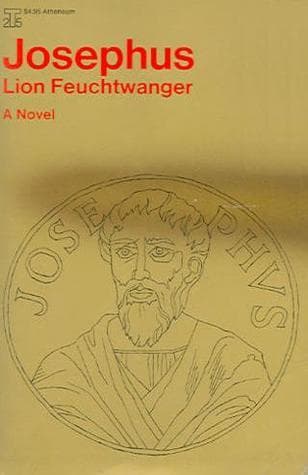
Josephus
About this book
Thruout his career Feuchtwanger was drawn to the theme of Jewishness. In his Josephus Trilogy (Josephus, 1932; The Jew of Rome, 1935; & Josephus & the Emperor, or The Day Will Come, 1942) he deals with the theme of nationalism versus cosmopolitanism by describing the development of Flavius Josephus, a Jewish historian of the first century. Toward the his life's end he took up the theme by writing about Raquel, the Jewess of Toledo (1955), who for seven years prevented Alfonso VIII of Castile from warring against the Moors. In Jefta & His Daughter (1957) he wrote about a man from the Hebrew bible who kept an oath to god by sacrificing his daughter.
Where to buy
No purchase options available at this time.
More by Lion Feuchtwanger

Black Water 2: More Tales of the Fantastic
Gabriel García Márquez, Amos Tutuola, Julian Barnes, Isabel Allende, A.S. Byatt, Giuseppe Tomasi di Lampedusa, William Goyen, Isaac Bashevis Singer, Bernard Malamud, Elizabeth Spencer, William Sansom, Grace Amundson, Liliana Heke, Ethel Wilson, Tommaso Landolfi, Eric McCormack, Brett Balon, Elizabeth Bowen, Dorothy K. Haynes, Ben Hecht, Archibald Colquhoun, Antonia White, Leon Rooke, Geoffrey Drayton, Mircea Eliade, Alberto Manguel, Ann Bridge, J.D. Beresford, Satyajit Ray, Yehuda Amichai, Boris Vian, Günter Grass, Sylvia Townsend Warner, Angus Wilson, Rohinton Mistry, Wolfgang Hildesheimer, Lion Feuchtwanger, Hanns Heinz Ewers, Friedrich Dürrenmatt, Joyce Marshall, James Stephens, Timothy Findley, Elizabeth Taylor, Yevgeny Zamyatin, V.S. Naipaul, Kenzaburō Ōe, Luigi Pirandello, Alfonso Reyes, Peter Green, Hortense Calisher, Chen Xuanyou
Die Brüder Lautensack
Lion Feuchtwanger
Exil
Lion Feuchtwanger

Jew Süss
Lion Feuchtwanger