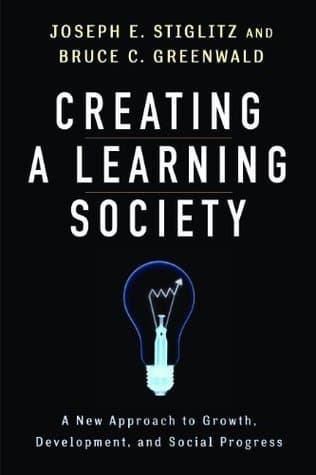
Creating a Learning Society: A New Approach to Growth, Development, and Social Progress
by Joseph E. Stiglitz, Michael Woodford, Philippe Aghion, Robert Solow, Kenneth Arrow
About this book
It has long been recognized that most standard of living increases are associated with advances in technology, not the accumulation of capital. Yet it has also become clear that what truly separates developed from less developed countries is not just a gap in resources or output but a gap in knowledge. In fact, the pace at which developing countries grow is largely determined by the pace at which they close that gap.Therefore, how countries learn and become more productive is key to understanding how they grow and develop, especially over the long term. In Creating a Learning Society, Joseph E. Stiglitz and Bruce C. Greenwald spell out the implications of this insight for both economic theory and policy. Taking as a starting point Kenneth J. Arrow's 1962 paper "Learning by Doing," they explain why the production of knowledge differs from that of other goods and why market economies alone are typically not efficient in the production and transmission of knowledge. Closing knowledge gaps, or helping laggards learn, is central to growth and development.Combining technical economic analysis with accessible prose, Stiglitz and Greenwald provide new models of "endogenous growth," upending the received thinking about global policy and trade regimes. They show how well-designed government trade and industrial policies can help create a learning society; explain how poorly designed intellectual property regimes can retard learning; demonstrate how virtually every government policy has effects, both positive and negative, on learning; and they argue that policymakers need to be cognizant of these effects. They provocatively show why many standard policy prescriptions, especially associated with "neoliberal" doctrines focusing on static resource allocations, impede learning and explain why free trade may lead to stagnation, while broad based industrial protection and exchange rate interventions may bring benefits, not just to the industrial sector, but to the entire economy.The volume concludes with brief commentaries from Philippe Aghion and Michael Woodford, as well as from Nobel Laureates Kenneth Arrow and Robert Solow.
Where to buy
No purchase options available at this time.
More by Joseph E. Stiglitz
Exposure: Inside the Olympus Scandal: How I Went from CEO to Whistleblower
Michael Woodford

Worlds Hidden in Plain Sight: The Evolving Idea of Complexity at the Santa Fe Institute, 1984–2019
Jennifer Dunne, Kenneth Arrow, John H. Holland, Geoffrey West, Murray Gell-Mann, W. Brian Arthur, David C. Krakauer, Harold Morowitz, Richard Lewontin, Jessica C. Flack
Fair Trade for All: How Trade Can Promote Development
Joseph E. Stiglitz, Andrew Charlton
Freefall: America, Free Markets, and the Sinking of the World Economy
Joseph E. Stiglitz