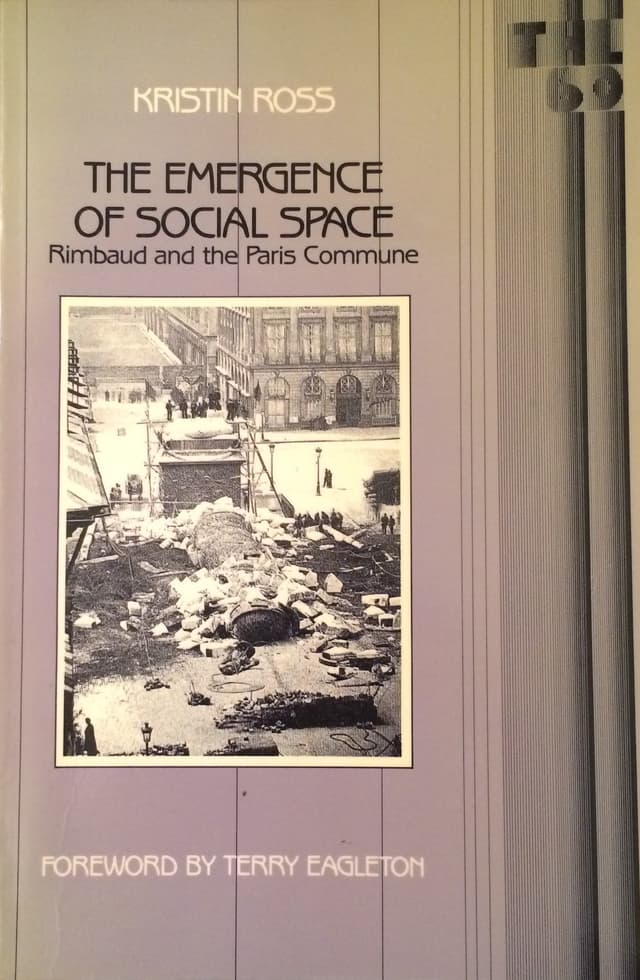
The Emergence of Social Space: Rimbaud and the Paris Commune
by Kristin Ross
About this book
The 1870s in France - Rimbaud’s moment, and the subject of this book - is a decade virtually ignored in most standard histories of France. Yet it was the moment of two significant spatial events: France’s expansion on a global scale, and, in the spring of 1871, the brief existence of the Paris Commune - the construction of revolutionary urban space. Arguing that space, as a social fact, is always political and strategic, Kristen Ross has written a book that is at once history and geography of the Commune’s anarchist culture - its political language and social relations, its values, strategies, and stances.Central to her analysis of the Commune as social space and oppositional culture is a close textual reading of Arthur Rimbaud’s poetry. His poems - a common thread running through the book - are one set of documents among many in Ross’s recreation of the Communard experience. Rimbaud, Paul Lafargue, and the social geographer Elisee Reclus serve as emblematic figures moving within and on the periphery of the Commune; in their resistance to the logic and economy of a capitalist conception of work, in their challenge to work itself as a term of identity, all three posed a threat to the existing order. Ross looks at these and other emancipator notions as aspects of Communard life, each with an analogous strategy in Rimbaud’s poetry. Applying contemporary theory to a wealth of little-known archival material, she has written a fresh, persuasive, and original book.
Where to buy
No purchase options available at this time.
More by Kristin Ross

Communal Luxury: The Political Imaginary of the Paris Commune
Kristin Ross

Democracy in What State?
Slavoj Žižek, Giorgio Agamben, Alain Badiou, Jacques Rancière, Wendy Brown, Kristin Ross, Jean-Luc Nancy, Daniel Bensaïd

Fast Cars, Clean Bodies: Decolonization and the Reordering of French Culture
Kristin Ross

May '68 and Its Afterlives
Kristin Ross