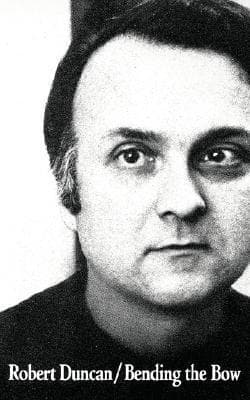
Bending the Bow: Poetry
About this book
In Bending the Bow , Robert Duncan is writing on a scale which places him among the poets, after Walt Whitman, bold enough to attempt the personal epic, the large-canvas rendering of man’s spirit in history as one man sees it, feels it, lives it, and makes it his own. In "Structures of Rime," the open series begun in The Opening of the Field and continued in this volume, Duncan works with ideas, forces, and persons created in language itself––the life and identity of the poet in the poem. With the first thirty poems of "Passages," which form the structural base in Bending the Bow , he has begun a second open series––a multiphasic projection of movements in a field, an imagined universe of the poem that moves out to include all the terms of experience as meaning. Here Duncan draws upon and in turn contributes to a mode in American poetry where Pound’s Cantos , Williams’s Paterson , Zukofsky’s “A,” and Olson’s Maximus Poems have led the way. The chronological composition of Bending the Bow emphasizes Duncan’s belief that the significance of form is that of an event in process. Thus, the poems of the two open series belong ultimately to the configuration of a life in poetry in which there are forms moving within and interpenetrating forms. Versions of Verlaine’s Saint Graal and Parsifal and a translation of Gérard de Nerval’s Les Chimeres enter the picture; narrative bridges for the play Adam’s Way have their place in the process; and three major individual poems––"My Mother Would Be a Falconress," "A Shrine to Ameinias," and "Epilogos"––among others make for an interplay of frames of reference and meaning in which even such resounding blasts of outrage at the War in Vietnam as "Up Rising" and "The Soldiers" are not for the poet things in themselves but happenings in a poetry that involve all other parts of his experience.
Where to buy
No purchase options available at this time.
More by Robert Duncan
City Lights Pocket Poets Anthology
Allen Ginsberg, Gregory Corso, Lawrence Ferlinghetti, Kenneth Rexroth, Antler, Harold Norse, Diane di Prima, Denise Levertov, Jacques Prévert, Anne Waldman, Pier Paolo Pasolini, Andrei Voznesensky, Jack Kerouac, Frank O'Hara, Bob Kaufman, Robert Bly, Jack Hirschman, Peter Orlovsky, Anselm Hollo, Robert Duncan, Ernesto Cardenal, Pablo Picasso, Jerome Rothenberg, Marie Ponsot, Kenneth Patchen, Philip Lamantia, Vladimir Mayakovsky, Daisy Zamora, Malcolm Lowry, Nicanor Parra, Robert Nichols, Janine Pommy-Vega, La Loca, Charles Upton, Antonio Porta, Alberto Blanco, Adam Cornford, Rosario Murillo, Pete Winslow, Stefan Brect
Contemporary American Poetry
Anne Sexton, Sylvia Plath, W.S. Merwin, Allen Ginsberg, James Dickey, Galway Kinnell, X.J. Kennedy, Donald Hall, Howard Nemerov, David Ignatow, Gary Snyder, John Ashbery, Denise Levertov, Etheridge Knight, James Wright, Robert Lowell, Frank O'Hara, Robert Creeley, William Stafford, Robert Bly, Richard Wilbur, Ron Padgett, A.R. Ammons, Robert Duncan, Louis Simpson, Anthony Hecht, Adrienne Rich, Tom Clark, James Merrill, John Woods, Reed Whittemore, Donald Justice, W.D. Snodgrass, Michael Benedikt, Dudley Randall, John Haines, Edgar Bowers
Roots and Branches: Poetry
Robert Duncan
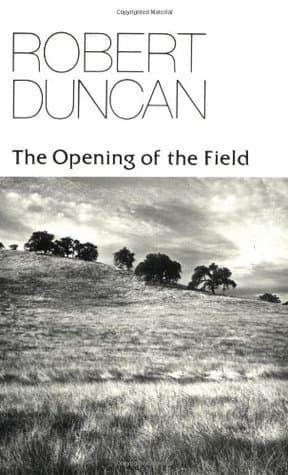
The Opening of the Field: Poetry
Robert Duncan