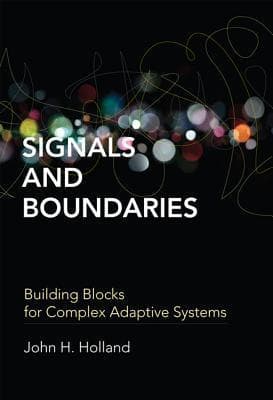
Signals and Boundaries: Building Blocks for Complex Adaptive Systems
About this book
Complex adaptive systems (cas), including ecosystems, governments, biological cells, and markets, are characterized by intricate hierarchical arrangements of boundaries and signals. In ecosystems, for example, niches act as semi-permeable boundaries, and smells and visual patterns serve as signals; governments have departmental hierarchies with memoranda acting as signals; and so it is with other cas. Despite a wealth of data and descriptions concerning different cas, there remain many unanswered questions about "steering" these systems. In Signals and Boundaries, John Holland argues that understanding the origin of the intricate signal/border hierarchies of these systems is the key to answering such questions. He develops an overarching framework for comparing and steering cas through the mechanisms that generate their signal/boundary hierarchies. Holland lays out a path for developing the framework that emphasizes agents, niches, theory, and mathematical models. He d
Where to buy
No purchase options available at this time.
More by John H. Holland
Complexity: A Very Short Introduction
John H. Holland

Emergence: From Chaos To Order
John H. Holland

Hidden Order: How Adaptation Builds Complexity
John H. Holland

Worlds Hidden in Plain Sight: The Evolving Idea of Complexity at the Santa Fe Institute, 1984–2019
Jennifer Dunne, Kenneth Arrow, John H. Holland, Geoffrey West, Murray Gell-Mann, W. Brian Arthur, David C. Krakauer, Harold Morowitz, Richard Lewontin, Jessica C. Flack