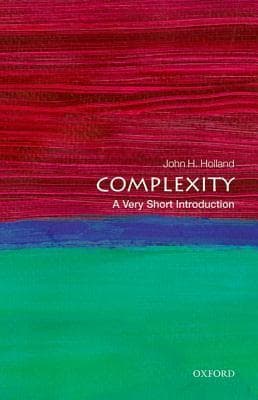
Complexity: A Very Short Introduction
About this book
The importance of complexity is well-captured by Hawking's "Complexity is the science of the 21st century". From the movement of flocks of birds to the Internet, environmental sustainability, and market regulation, the study and understanding of complex non-linear systems has become highly influential over the last 30 years.In this Very Short Introduction , one of the leading figures in the field, John Holland, introduces the key elements and conceptual framework of complexity. From complex physical systems such as fluid flow and the difficulties of predicting weather, to complex adaptive systems such as the highly diverse and interdependent ecosystems of rainforests, he combines simple, well-known examples -- Adam Smith's pin factory, Darwin's comet orchid, and Simon's 'watchmaker' -- with an account of the approaches, involving agents and urn models, taken by complexity theory.ABOUT THE The Very Short Introductions series from Oxford University Press contains hundreds of titles in almost every subject area. These pocket-sized books are the perfect way to get ahead in a new subject quickly. Our expert authors combine facts, analysis, perspective, new ideas, and enthusiasm to make interesting and challenging topics highly readable.
Where to buy
No purchase options available at this time.
More by John H. Holland
Emergence: From Chaos To Order
John H. Holland
Hidden Order: How Adaptation Builds Complexity
John H. Holland
Signals and Boundaries: Building Blocks for Complex Adaptive Systems
John H. Holland
Worlds Hidden in Plain Sight: The Evolving Idea of Complexity at the Santa Fe Institute, 1984–2019
Jennifer Dunne, Kenneth Arrow, John H. Holland, Geoffrey West, Murray Gell-Mann, W. Brian Arthur, David C. Krakauer, Harold Morowitz, Richard Lewontin, Jessica C. Flack